
Eight months, seven wins: luxury's streak breaks and BMW's lead thins to 49 cars
August luxury registrations fell 2.4% to about 3,907 — 2026's first year-on-year decline. Mercedes-Benz fell harder than BMW, so BMW still leads, by 49 cars against July's 157. Jaguar Land Rover took a record 14.9% share while selling exactly one electric car. Audi is estimated, not counted.
Mercedes retakes the map
BMW led 8 of India's 10 biggest luxury states in July. In August it led 6 — Mercedes took back Haryana, Telangana and Chandigarh, and the two are dead level in Uttar Pradesh at 75 cars each. The league lead survived; the map lead did not.
Telangana stays luxury's electric capital: 33.6% of its 226 registrations were electric, up from 31.3% in July, and it is one of the states that flipped to Mercedes. At the other pole, Chandigarh was the country's busiest luxury RTO in August — 128 cars, up 66.2% year on year — and put just 9 of them on a plug, a 7.0% electric share. The UT of DNH and DD registered 139 luxury cars and exactly two that could be charged.
The streak ends at seven
For seven straight months of 2026, luxury beat its 2025 twin. August broke it. India registered about 3,907 luxury cars — 3,585 counted by Vahan plus an estimated 322 Audis — down 2.4% on the 4,003 of August 2025 and down 14.3% on July's 4,561. It is the segment's first year-on-year reverse of the year, and a sharp turn from June's +21.3% high.
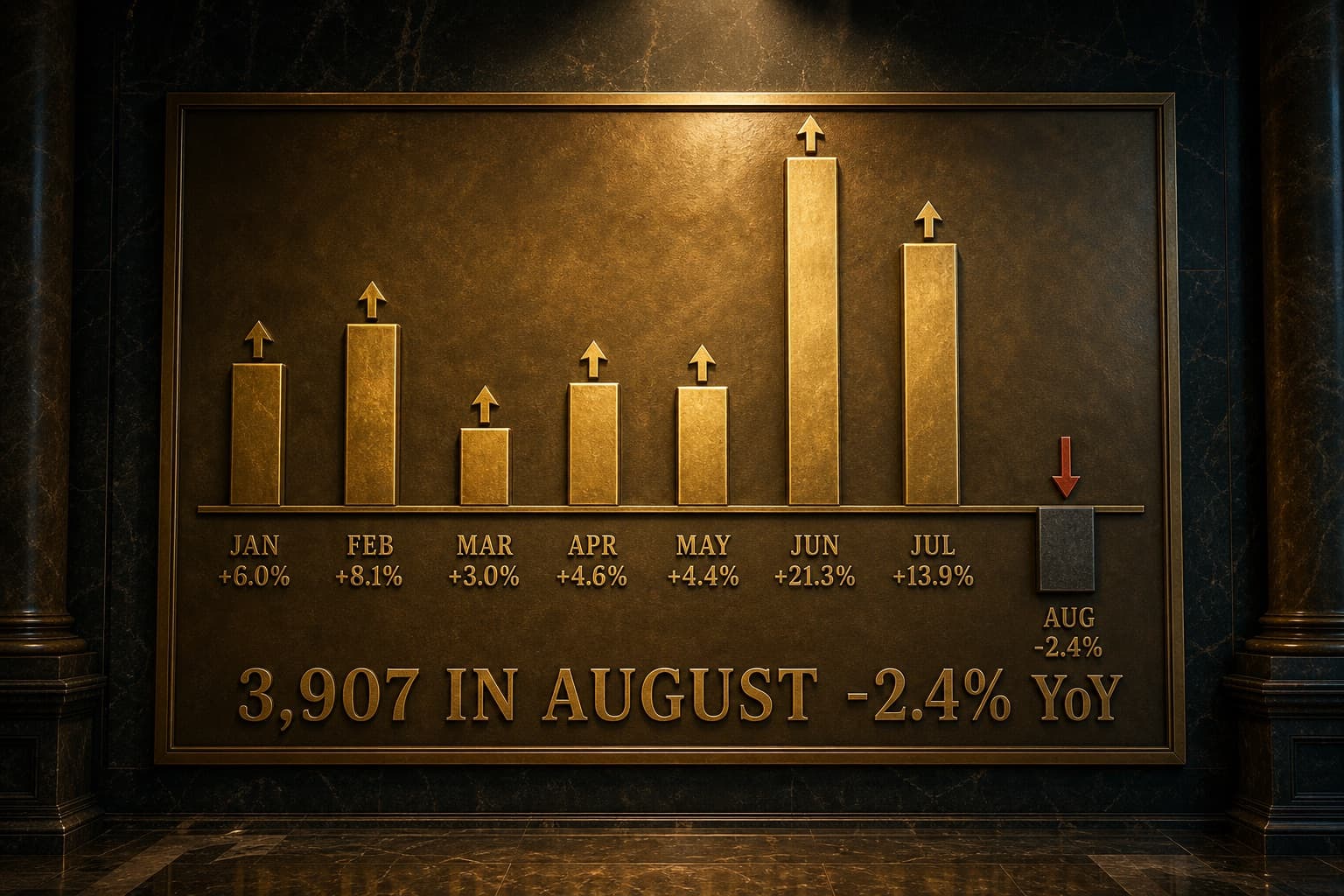
49 cars of daylight
BMW kept first place without growing: it shrank 0.6%, Mercedes-Benz shrank 5.4%.
BMW booked 1,439 registrations for 36.8% of luxury; Mercedes-Benz took 1,390 and 35.6%. The gap — 49 cars, 1.3 pp — is the second-narrowest of BMW's eight-month winning run, beaten only by May's 21. In July it was 157 cars and 3.4 pp.
The reason is not BMW strength. Munich itself fell 0.6% year on year; Stuttgart fell 5.4%, and it is that wider drop, not any BMW surge, that keeps the order intact. Mercedes has now given up 1.1 points of share in a year and has not led a month since February. Volvo slid 8.7% to 115 cars, and Porsche — 58 cars, down 28.4% on the year — at least climbed well clear of July's floor of 34.
Audi* sits fourth on an estimated ≈322 cars, 8.2% of the market. Vahan does not report it as a separate maker, so the figure is scaled from published half-year data and carried inside every market total and share on this page — leaving it out would quietly inflate everyone else. The rank is firm; the number is indicative. Sourcing is set out under the table and in the note on coverage at the foot of this article.
| # | Maker | Regs | Market share | YoY shift |
|---|---|---|---|---|
| 1 | BMW | 1,439 | 36.8% | +0.7 pp |
| 2 | Mercedes-Benz | 1,390 | 35.6% | -1.1 pp |
| 3 | Jaguar Land Rover | 583 | 14.9% | +2.4 pp |
| 4* | Audi* | ≈322 | ≈8.2% | est. |
| 5 | Volvo | 115 | 2.9% | -0.2 pp |
| 6 | Porsche | 58 | 1.5% | -0.5 pp |
* Audi is an estimate, not a Vahan count — and it is inside every share in this table. Vahan does not report Audi as a separate maker (its named entity shows 11 cars in August), so leaving it out would inflate everyone else's share. We therefore size Audi from published half-year data and include it in the market base: Autocar India reports 2,182 units for January–June 2026, which we scale by each month's segment seasonality to give ≈322 cars in August and a market of ≈3,907 rather than the 3,585 Vahan alone sees. Fourth place is firm; the number is not. A second outlet, AutoPunditz, reports 2,748 for the same half-year — a 26% disagreement we cannot resolve. Registrations for the five Vahan marques are exact; only Audi's is modelled.
Jaguar Land Rover's record month, on one electric car
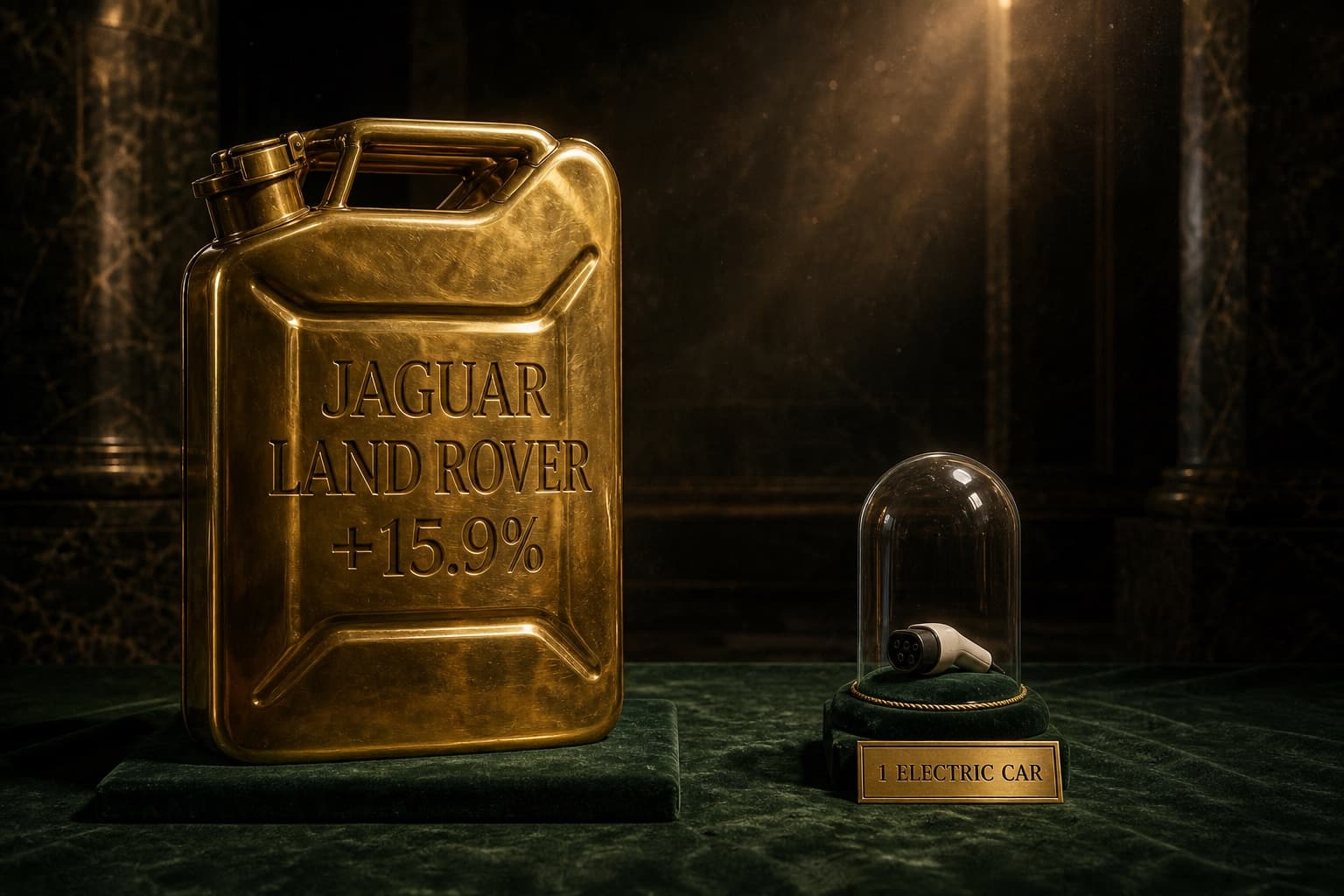
In a month when every other marque shrank, Jaguar Land Rover grew: 583 cars, +15.9% year on year, for a 14.9% share — its highest of any completed month in this data window, beating the 14.3% of September 2025. It is the only grower in the league.
What makes the record strange is how it was won. Of those 583 cars, exactly one was electric. JLR's rise is a pure combustion rise, achieved in the same month the segment's electric share fell to its lowest since February. Whatever is pulling luxury buyers back toward the Range Rover, it is not the plug.
How 2026 peaked and turned
- Dec 2025The flipBMW takes its first monthly lead in this data — 45.5% to 40.2%, a margin of 206 cars.
- Mar 2026The plug's best springElectric reaches 16.3% of luxury on its way to a June peak of 18.8% - still little more than half of diesel's share.
- Jun 2026The high-water markLuxury jumps 21.3% YoY to about 4,709 cars and 18.8% of the Vahan-counted month goes electric.
- Jul 2026BMW's widest lead42.2% to 38.4% — 157 cars — plus 62.9% of every luxury EV sold.
- Aug 2026The tide goes outFirst YoY decline of 2026; BMW's lead thins to 49 cars and diesel retakes electric.
Diesel is more than a quarter of luxury, and growing
Electric has never once outsold diesel in luxury. The old split only made it look that way.
Two notes on basis first. Every hybrid here is counted as the fuel it actually burns — a petrol-hybrid is petrol, a diesel-hybrid is diesel — so there is no separate hybrid column. And Audi, which Vahan does not break out, is carried at its estimated volume and assigned in full to petrol, so the mix reconciles to the whole market. On that basis August was 59.4% petrol (≈2,321 cars), 28.9% diesel (1,130) and 11.7% electric (456).
Diesel is the story. It grew 10.4% year on year in a market that shrank, lifting its share 3.3 points to its highest since October 2025 — comfortably more than a quarter of every luxury car sold. Petrol fell 3.7% and holds a clear majority at 59.4%. Electric fell 19.6% on the year and 27.6% on July alone, down to 11.7% and its lowest share since February.
Counted the other way, with hybrids pulled out into a category of their own, diesel would read as just 14.6% and it would look as though the plug had spent five months ahead of the pump. It had not. Diesel has outsold electric in luxury in every month since January 2025, never by less than six percentage points. The crossover was an artefact of where the diesel-hybrids were filed.
The socket still says BMW
Luxury's electric market shrank by a third, and BMW's grip on it did not loosen at all.
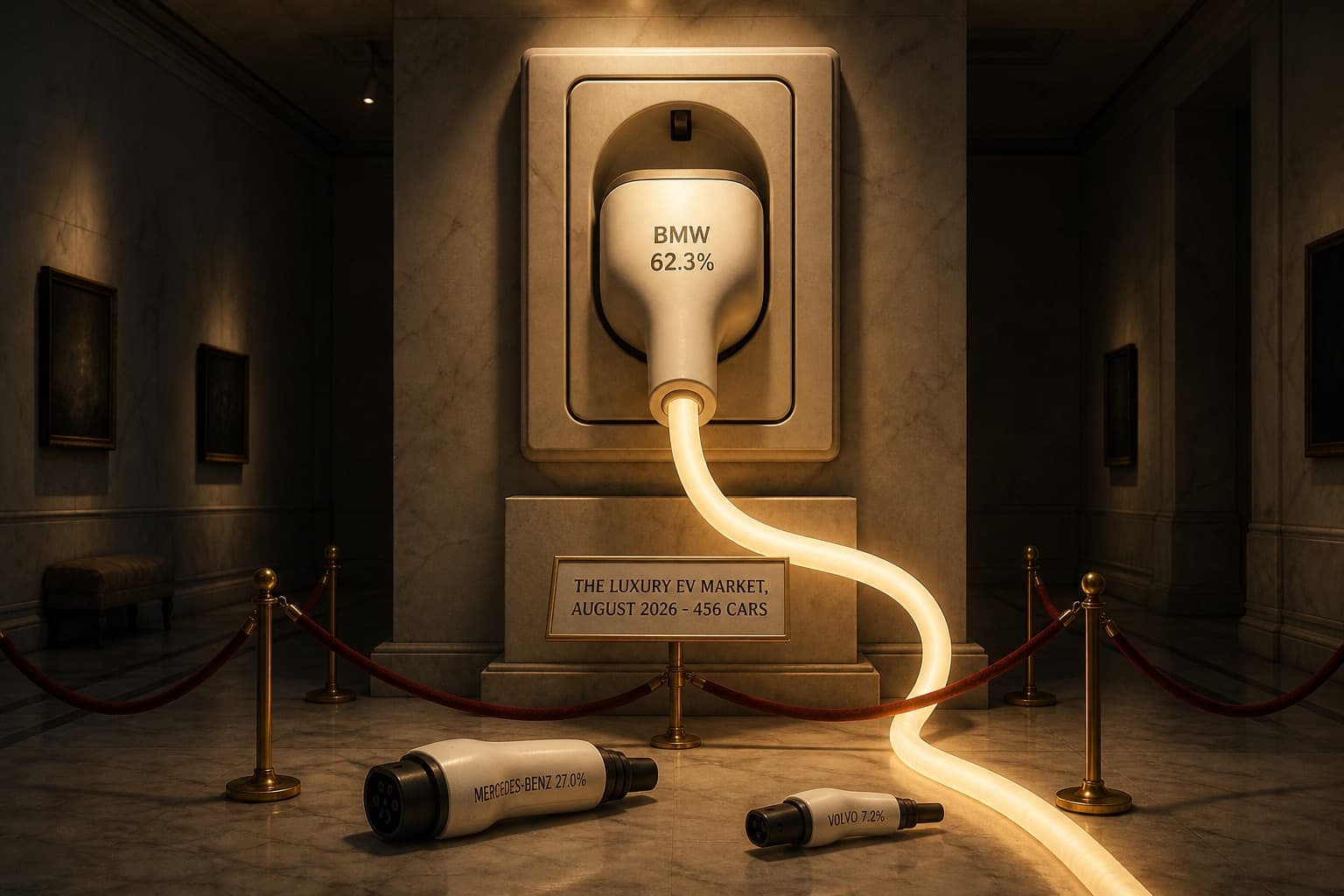
The one throne BMW did not have to defend was the electric one. It registered 284 luxury EVs — 62.3% of the entire luxury EV market, statistically unchanged from July's 63.0% even as the market beneath it fell away. Mercedes managed 123 and 27.0%.
The intensity numbers tell the softer story: 19.7% of BMWs registered in August were electric, down from 22.5% in July, against just 8.8% of Mercedes. The real purist remains Volvo — 33 EVs out of 115 cars, 28.7% of its own volume, the highest electric intensity in the league on a fraction of the scale. Porsche managed 15 EVs from 58 cars. JLR, as noted, managed one.
The road ahead
Three things to watch as the numbers mature further. First, whether the decline survives at all — August has already back-filled once, and a fully settled month may yet print flat. Second, whether Jaguar Land Rover's record 14.9% was a one-month artefact of everyone else's bad month or the start of something. Third, whether luxury's electric share climbs back off 11.7% into the Diwali quarter, the segment's fattest — because BMW's 62.3% of the plug is worth a great deal more when the plug is 19% of the market than when it is 13%.